American GI demonstrates how to lay communications wire across a gap (river, deep ravine, etc.) with a dummy rifle grenade, probably from an MX-306/G wire dispenser..
OK, some of the responses to my post yesterday on
reproduction M76 rifle grenade launchers convinced me that I need to do this tutorial for American militia on training (aka "dummy") rifle grenades.
I will skip the commercial about how the practice of the art and science of the rifle grenadier is good, clean fun and totally legal. I will also skip the observation that a rifleman with the capability to launch grenades from his rifle AND HIT WHAT HE IS AIMING AT brings his own direct and indirect artillery support to the battlefield. I will further neglect to expound on the point that thousands of armed citizens at play with dummy rifle grenades, demonstrating increasing knowledge and competitive excellence, has a deterrent effect in the minds of certain people who wish to further circumscribe our liberties.
Having neglected all of that, on to the show.
Training munitions are as old as the wooden swords that the Romans used to train their recruits with. In the US military up until the transition from RGs to the 40mm grenade launchers in Vietnam, the principal training rounds were the

M11A4 anti-personnel grenade and the

M31 anti-tank grenade.
These can still be found at gun shows and on-line but they are quite expensive and, being made out of sheet metal, VERY fragile. If you get more than 1 or 2 shots out of them without catastrophic damage to the round itself you must be incredibly lucky or doing something wrong.
 Viet Cong with an M44 7.62x54R carbine mounting a US anti-personnel rifle grenade.
Now if you're the U.S. government, such wastage is just fine. But in case you haven't noticed, our supply line is considerably shorter and thinner. Other governments, principally the Israelis and the former Yugoslavia, came up with robust and durable training munitions (both on the NATO standard 22mm).

Here are Israeli training grenades with a rubber warhead that is well-nigh indestructible. The only thing that can possibly break on the thing are the plastic fins and I have yet to have that happen. (More about these later.)
The Yugoslavians fielded two main types of rifle grenades for their SKS & AK variant rifles.
InertOrd.net has this image showing both:

The larger of the two training versions is the Yugoslavian Model M68 Anti-Tank practice rifle grenade.

The M68's "warhead" is made of a white opaque polymer, and it is capped with a thick piece of rubber for repeated use.
The other looks like this:
 Yugo training munition with SKS rifle.
And, as an aside, here is how the Serb police field them:

You can find all of these in onesies and twosies offered for sale at gun shows and on-line. Unfortunately, to my knowledge no one has made a systematic effort to import the Yugo examples in any quantity (the Israeli well, plumbed previously by Numrich Arms, it seems is now dry). There's an investment opportunity for somebody with a little money (i.e., somebody not me).
Service of Supply offers reusable dummy rifle grenades for World War II re-enactors.


 Marine training with WWII-vintage M1A2 fragmentation rifle grenade adapter.
Also still available in somewhat greater quantities and lesser prices are the M1A2 and M2A1 adaptors for projecting hand grenades of various shapes off of a rifle grenade launcher. Here are two images of the M1A2:


And one of the M2A1:

These can used by the militia grenadier trainee by substituting dummy frags (I think you call them "paperweights" these days) in the case of the M1A2 or expended smoke grenade canisters (or even short PVC tubes filled with Play-Doh for weight) in the case of the M2A1.
There was a guy in Miami who, several years ago, was selling M1A2s for a dollar a pop in case lots. While that supply is long gone, you often can find them being resold at gun shows for as little as $5 each.
For those of you who do not wish to run the risk of playing with "paperweights". . .
(You may recall that the first ATF attention that the Davidians received was when a UPS driver reported the delivery of a broken case of such "paperweights". Yes, they were and are legal, and the Davidians are still dead.)
You will note on the first image of the M1A2 above that the fingers holding the frag to the adapter body are attached with screws. These are easily removed leaving you with a tail end that can easily (using those same screw holes) be improvised to hold on a pvc pipe front end filled with Play-Doh).
Speaking of improvisations, I noted this comment at the M76 post:
Anyone have a source for 22mm ID pipe, either PVC or aluminium? Due to high prices of training/practice rifle grenades, I've been wanting to build some practice grenades for about a year, but haven't found anything that will fit the 22mm flashhider/grenade launcher. 1/2 inch pvc pipe coupling is too large and is too wobbly, but it's the closest I've found so far.
Under
NO circumstances should you use PVC for the back-end of a rifle grenade projectile of any kind. Because of the weight of the projectile, the pressures you are dealing with are, if anything, even greater than those generated by a standard round. Even aluminum must be thick enough to handle the pressure. Thin-walled seamless steel tubing is the material of choice.
There are sources for this out there, although they take some tracking down. The easiest way is to find somebody who bought one of these Israeli kits from Numrich Arms a few years ago:

The kits sold for a couple hundred bucks apiece and contained six complete training rounds as illustrated above. They also contained replacement parts that are hardly ever used, to the tune of 40 plastic fins, 32 body tubes, 12 outer sleeves, 30 spacer rings, 24 locking nuts plus 2 nut wrenches and 1 key wrench and 20 M16 ladder sights and 30 Galil ladder sights in 35/60/85 meter graduations.
See those golden beauties in the center of the box with some laid out in front? It is the 32 body tubes that we immediately noticed because with these and the plastic fins, you have the ass end of an improvised rifle grenade that will, with the threading on of a suitable base plug in the dummy warhead, make a unit that will withstand the pressures of launch.

I cannot emphasize enough that playing around with firearms involving improvisations of any sort, especially launching rifle grenades, even dummy ones, is not for the incautious or slow of wit. I say this with all the sincerity generated by my own scars of experience.
You should
NEVER assume that any rifle, even one with an integral grenade launcher such as the Yugo SKS, can stand the pressure of launching a rifle grenade.
YOU MUST TEST USING A LONG LANYARD ATTACHED TO THE TRIGGER OF A RIFLE THAT IS SECURELY LASHED TO A RANGE TABLE OR TEST FIXTURE. And make it a
long lanyard.
Further, it is always a good idea to use standard blanks, rather than grenade blanks, to get the feel of the art. A standard 7.62x39 blank, for example, will still hurl an Israeli practice grenade 70 yards or so. A grenade blank can make that puppy sail for 300 plus meters.
Range Tales of the Stupid:
I will tell this one on myself. Back before we got a star crimp die and started rolling our own 7.62x39 GL cartridges, bright boy here got the idea that perhaps we could boost the performance of a standard blank by slipping an Estes model rocket motor in the ass end of an Israeli rifle grenade.
Theory: The standard blank would launch the grenade off the Yugo SKS, ignite the motor, which would boost the range beyond 70 yards.
Practice: I violated my own previously well-established safety rule of the lanyard and put the sucker to my shoulder at the range table with a buddy standing nearby and pulled the trigger. We got enhanced performance all right. The blank over-pressure
detonated rather than ignited the Estes motor and with a deafening WHOOOM! the Israeli grenade assumed earth escape velocity, vanished in a nano-second over the back stop on a laser-like trajectory, and the engine fragments blew out the back, drawing blood from both of us. The recoil damn near knocked me down and my shoulder throbbed for a week. It took weeks for the bruise to disappear. We never did find that dummy grenade and I'm convinced that it is still floating somewhere out beyond Mars. The SKS, amazingly, was unharmed.
Boys and girls, don't try THAT one at home.
Another caution about rifle grenades. See this guy adopting the standard Army method of engaging a target with direct fire, such as when you take on a tank with an AP projectile?

Trust me, this GI's shoulder hurt like hell from the recoil afterward. It is intense. Not life-threatening or bone-breaking, just . . . intense. You only do this when you must.
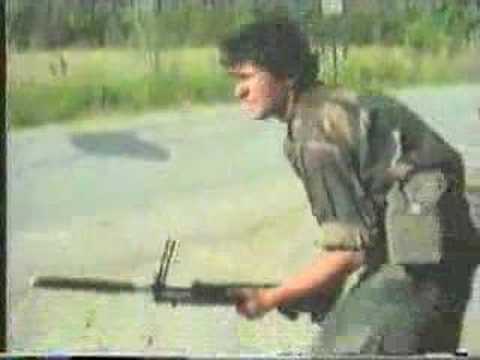
Here is another way of launching direct fire, which saves your shoulder but risks your wrists. It is also generally far less accurate.
 SKS grenadier during the Yugoslav break-up wars.
We practice most often with RGs in indirect fire mode, as in the photo at the top of this post. My experience has taught me to forget about rifle grenade sights and just use Kentucky windage acquired from regular practice. You'd be amazed how often you can put one in a 55 gallon drum at 200 meters once you have a bit of experience.