The repeat of the following posts, first published in June and July of 2010, was requested by a reader who was having trouble finding them. Such equipment has gotten scarcer since then and prices have gone up. Still, another reader reported the other day that he had picked up two TA-1s and a DR-8 reel full of wire for $75 at a yard sale! Lucky him. Anyway, here is my thumbnail briefing on field wire and field telephones.

Field telephones are mobile telephones intended for military use, designed to withstand wartime conditions. They can draw power from their own battery, from a telephone exchange (via a central battery known as CB), or from an external power source. Some need no battery, being sound-powered telephones. Field telephones were first used in the First World War to direct troops. They replaced flag signals and the telegraph as an efficient means of communication. The first field telephones had a wind-up generator, used to power the telephone's ringer & batteries to send the call, and call the manually-operated telephone central. This technology was used from the 1910s to the 1960s. Later the ring signal has been made electronically operated by a pushbutton, or automatic as on domestic telephones. The manual systems are still widely used, and often compatible with the older equipment. -- Wikipedia.
Over the years my friends and I have picked up quite a few field telephones, switchboards, miles of military WD1-TT wire and the reels and other tools to deploy and retrieve the wire and connect the phones for tactical communication. Some folks have doubted my sanity. "What do you need those for?" I am often asked by people who notice the boxes of equipment and reels of field wire in my garage. Well, strictly speaking, I
DON'T need them. But I
MIGHT need them one day. First let me give you a little history and then try to explain my thinking.
The United States Army first used field telephones on a large scale during World War I. (You can find an excellent synopsis history of U.S. field telephony at WLHoward.com entitled US Army Wire Communication WW I to Present
here.)
This coincided with the adoption of the radio as a military communication device, but early radios were even more unreliable than early field telephones, so the Army used both. Even though radios have become much more reliable and ubiquitous, the military continued to use field telephones in the early 21st Century because they filled a niche need.
First of all, field telephone communication is both stealthy and secure, as you do not broadcast a signal into the ionosphere where messages can be noted, intercepted, decrypted and transmitters located and destroyed. Field telephones are not, of course, as mobile as radios as they depend upon wire nets.
This is mostly why many militias eschew field telephones in favor of radios. But what happens when the radios don't work or can't be used? Let me give you some possible scenarios to chew on.
EMP events, whether solar or nuclear generated, are a very real possibility. Unshielded electronics can be easily fried. Modern digital communications are particularly vulnerable. How many of you have a back-up plan for communications in the event of EMP? Do you have extra radios with solar chargers packed away in Farraday-shielded containers? All my field phones are.
 TA-1 sound-powered field telephone.
In addition, half of my field telephones are sound-powered TA-1s, which require no batteries. The other half are TA-312s (or the earlier version, TA-43s) which although are designed to be battery-operated on two D-cells can also be operated without them using the sound-power principle.
The TA-1/PT, built to US military specifications, is a one-piece sound-powered field telephone for use on two-wire field lines in forward tactical areas. It can communicate with other field telephones or field and fixed-base LB switchboards. The TA-1/PT is equipped for transmission signaling with a built-in signal generator and for receive signaling with an audible buzzer and volume control. Additionally, a visual indicator on the handset is utilized for silent receive signaling. The set is carried in an all-weather carrying case with shoulder strap, or attached to a field belt with an integral belt clip. Voice transmission range is 6.4 km with WD-1/TT field wire. The set weighs 0.8 kg with carrying case. Signal voltage is 20 Hz, 65 to 80 V. -- Jane's Military Communications.
 TA-312 field telephone.
Built to US military specifications, the TA-312A/PT telephone set is a two-wire, battery-operated tactical system. It can be used as a point-to-point Voice Frequency (VF) wire communications link or in any two-wire ringdown subscriber positions of a telephone communications system. The 4.2 kg telephone set is ruggedised for all-weather field communications requirements, and can be utilized as a desk- or wall-mounted telephone in fixed or mobile military shelters or command posts requiring intercommunications between shelters and field operations. The TA-312A is used either as a Local Battery (LB) or Common Battery (CB) manual telephone and can be set up for operation as a local battery telephone, using Common Battery Signaling (CBS). Additionally, the telephone set is used to control remotely operated radio links by operation of the press-to-talk switch on the telephone handset. The TA-312A has special circuits to reduce or clip high-voltage line surges in the receive mode, and side tone balance is maintained over a range of voice frequencies and battery voltages. The TA-312A can be adapted to interface with automatic switchboards, such as the SB-3614 tactical switching centre, by using the optional TA955/PT tone signaling adaptor. Power requirements are two 1.5 V batteries in the LB mode, 48 V DC in the CB mode. -- Janes Military Communications.

My friends and I joke that after any future EMP burst or solar event, we'll go into business as the Alabama Telephone and Telegraph Company, because we'll have the only phones around that don't require electricity.
Those of you who have read John Rawles book Patriots are familiar with his description of the use of TA-1s to communicate between a hardened defensive position and an out-lying listening post/observation post. While I have one bone to pick with Rawles' scenario, this is not a far-fetched idea. With the apparent impending economic collapse portending (along with all the evil societal implications attendant to that), it may well be that the Obamanoids don't get around to starting a final battle for the Founders' Republic before the whole house of cards falls in on all of us.
In such a case, alternate communications systems such as military field telephones (or improvised systems, see below) could be critical to community defense.
WIRE AND TELEPHONE EQUIPMENT
When in the defense, units normally communicate by wire and messenger instead of by radio. Your leaders will often have you lay the wire and install and operate the field phones.
WIRE-LAYING TECHNIQUES
A surface line is field wire laid on the ground. Lay surface lines loosely with plenty of slack. Slack makes installation and maintenance easier. Surface lines take less time and fewer soldiers to install. When feasible, dig small trenches for the wire to protect it from shell fragments of artillery or mortar rounds. Conceal wire routes crossing open areas from enemy observation. Tag all wire lines at switchboards and at road, trail, and rail crossings to identify the lines and make repair easier if a line is cut.
An overhead line is field wire laid above the ground. Lay overhead lines near command posts, in assembly areas, and along roads where heavy vehicular traffic may drive off the road. Also, lay them at road crossings where trenches cannot be dug, if culverts or bridges are not available. Those lines are the least likely to be damaged by vehicles or weather.
To install the TA-1 telephone:
* Strip away half an inch of insulation from each strand of the WD-1 wire line.
* Depress the spring-loaded line binding posts and insert one strand of the wire into each post.
* Adjust signal volume control knob to LOUD.
* Depress the generator lever several times to call the other operator and listen for buzzer sound.
* Turn the buzzer volume control knob until the wanted volume is obtained.
* Look at the visual indicator to see if it shows four white luminous markings.
* Depress the push-to-talk switch to reset the visual indicator.
The telephone set TA-312 is a battery-powered phone. It has a range of 38 km using WD-1 wire.
To install the TA-312 telephone:
* Strip away one-half inch of insulation from each strand of the WD-1 wire line.
* Depress the spring-loaded line binding posts and insert one strand of the wire into each post.
* Adjust buzzer volume control knob to LOUD.
* Turn the INT-EXT switch to INT.
* Turn the circuit selector switch to LB.
* Insert the two BA-30 batteries into the battery compartment (one up and one down).
* Seat the handset firmly in the retaining cradle.
* Turn the handcrank rapidly a few turns. Remove the handset from the retaining cradle and wait for the other operator to answer.
* Depress the push-to-talk switch to talk. Release the push-to-talk switch to listen.
Rawles' survivalist scenario envisioned a single LP-OP overlooking the road. In real life, this leaves the rest of the perimeter open to surprise attack. In real life, a secure position requires eyes on all 360 degrees, and thus a number of LP-OPs all linked in a "platoon hot-loop."


The "hot-loop" links all the phones together without a switchboard. For small units, there is also a light-weight switchboard available, the SB-993.

The SB-993/GT is a lightweight, portable switchboard capable of handling six local-battery telephone lines. It is designed for use in forward combat areas and requires the use of either a local-battery telephone or a sound-powered telephone.

The SB-993 requires no power of its own. Each terminal has a small neon light within it which lights up when a call comes in. By stacking the terminals from the various phones together, one on top of the other, the switchboard operator can connect phones or entire loops together. The entire assembly weighs less than 4 pounds. The manual for the SB-993/GT can be found
here.There is a larger, more capable portable switchboard, the SB-22A/PT.

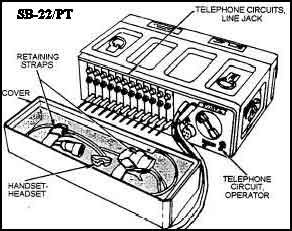
The SB-22A/PT is a tactical manual switchboard that can be rapidly installed to provide field facilities for interconnecting 12 local-battery telephone circuits, remote controlled radio circuits, or voice frequency (VF) teletypewriter circuits. Two SB-22/PTs may be stacked to provide a 29-circuit capability by removing one TA-221/PT (operator's pack) and inserting five TA-222/PTs (line packs). Replacing a line pack with a trunk pack permits one-way ringdown and one-way automatic trunk circuits between the SB-22A/PT and any other switchboard with common-battery signaling. Operating off 4 D-cells, it weighs 34 pounds.
Obviously the SB-22 would be best for more-or-less permanent field wire set-ups, although it is designed to be portable.
Generating the signal is one thing, routing it is another, but neither telephone nor switchboard are any good with field wire. The most common USGI field telephone wire is the WD-1/TT.

WD-1/TT and WD-1A/TT have two twisted, individually insulated conductors. The only difference between the two is that the WD-1A/TT has two insulated conductors bonded together. The conductors are four tinned-copper strands and three galvanized-steel strands with an inner insulation of polyethylene and an outer nylon insulation jacket. The wire's tensile strength is approximately 200 pounds (both conductors) and it weighs 48 pounds per l.6 kilometers (1 mile).
As field telephones and the equipment they linked to became more sophisticated, the military also procured a four-wire field cable which looks like two strands of WD-1/TT twisted together, the WF-16/U. It has four copper-cadmium alloy standard insulated conductors in two pairs. One pair is olive drab; the other brown. The olive drab conductor has a ridge along the side for night identification. WF-16/U weighs 62 pounds per 1.6 kilometers or 1 mile.

Reel Equipment CE-11 is a lightweight portable unit designed to be carried by one person. It consists of Reel Unit RL-39 and a sound-powered telephone handset with case and carrying strap. Reel Unit RL-39 mounts Spool DR-8 having a capacity of .4 kilometer (1/4-mile) or Field Wire WD-1/TT or WD-1A/TT. . . When Telephone Set TA-1/PT is used, it is carried on the belt.
We have experimented with unwinding WF-16 into two separate wires, much like WD-1/TT. In this manner we generate more two conductor wire which we load onto empty DR-8B reels.
 Empty DR8B reel, showing connecting blocks on side.
Which brings us to reels. The DR-8B is the smallest tactical reel, holding about 400 meters of WD-1/TT.
 DR-8B reel with RL-39 reel equipment handles, crank and strap.
Reel Unit RL-39 is a chest-type reel having an axle with carrying handles, carrying straps, and a crank for rewinding. Reel Unit RL-39 mounts Spool DR-8-A, which has a capacity of .4 kilometer (1/4-mile) of Field Wire WD-1/TT or WD-1A/TT (wire not included as a component). Lines may be laid with this equipment either by handcarrying the reel or by strapping it to the back. To recover telephone wire, the wireman snaps the carrying handles to the carrying straps and rotates the reel with the crank and axle. This reel is normally used to lay short local circuits, up to .4 kilometer (1/4-mile) over difficult terrain, or in a forward combat area.
You will see these often in war movies being used as demolitions wire.
There are two other reels commonly encountered.
 An RL-159 reel mounted on a Reel Unit RL-31-E and a larger DR-5 reel sitting on end beside it.
The RL-159/U reel is a metal spool-type container used to store, transport, lay, or recover field wire. It will hold 1.6 kilometers (1 mile) of field wire and can be mounted on Reeling Machine RL-207/G, Reel Unit RL-31-E, Reeling Machine RL-172/G, or Axle RL-27().
The larger DR-5 reel is a metal spool-type container used to store, transport, lay, or recover field wire. It will hold 4 kilometers (2.5 miles) of field wire and can be mounted on Reeling Machine RL-207/G, or Reel Unit RL-31-E.
With the larger reels, larger reel equipment is necessary to pay out or recover the wire.
 Recovering wire on an RL-159 reel using an RL-27 axle.
 Axle RL-27-B is used to lay and recover field wire. The axle is a machined-steel bar (2 1/2 feet long) used for mounting wire reels. The axle has two knurled handles, one removable for mounting Wire Reel RL-159/U on the axle. The axle has roller bearings and is equipped with a removable crank for re-winding wire. The axle can be carried by two individuals or placed on some improvised mounting.

The Reel Unit RL-31-E is a light-weight, portable, folding A-frame of steel tubing used for paying out and recovering field wire and field cable. The reel unit features:
· Brake unit for controlling speed of the reels during payout of the wire.
· Crank for reeling in wire on reels.
· Carrying strap for carrying the reel unit litter style.
· Divided axle when two reels are mounted on the reel unit. This axle allows either reel to operate independently. (When the divided axle is used, two cranks and two brakes are necessary for operation. They are issued with the equipment.)
The reel unit can carry a single Reel DR-5 or DR-15-B, or two Wire Reels RL-159/U. Reel Unit RL-31-E can be mounted on ground or vehicle. A special vehicular installation kit is available.

Now, I will be the first to admit that military wire, whether WD-1/TT or WF-16/U, is becoming scarcer and more expensive. So too are the phones. There are ways to substitute or improvise for the wire, however.
For example, railroad linemen used to use field telephones that just hooked up to the rails. In
this old issue of The American Telephone Journal the U.S. Army Signal Corps is reported to have used barbed wire fences out west for wire-substitutes. In addition, of course, any two conductor wire with reasonable weather-proofing can be used. Plain old speaker wire, for example.
Also, there has been considerable work by cave rescue folks to improvise the phones themselves. For example, go
here and
here.
The bible for military field telephone communications techniques and equipment is FM 24-20.
If you do nothing else, start thinking now about what happens if or when you cannot access the sophisticated technology you now rely upon. Once you've thought it through, then start getting ready to improvise, adapt and overcome.
Mike
III
A later post on Field Wire Dispensers:
 Paying out field telephone wire by hand using an MX-306/G wire dispenser.
The Wire Dispenser MX-306/G is a cylindrical canvas and tape container that holds approximately .8 kilometer (1/2-mile) of Wire WD-1/TT or WD-1A/TT field telephone wire.
 Photo of MX-306/G from FM 24-20, Field Wire and Field Cable Techniques.
The MX-306/G is easier to pay out than wire on a reel because you have no moving parts to generate drag. Most often the dispenser is mounted on a packboard or ALICE frame and is automatically laid as the linesman walks along.

The wire of two or more dispensers may be pre-spliced in tandem when it is necessary to lay a wire line of more than .8 kilometer (1/2-mile) without stopping to splice.
 US MX-306/G wire dispenser.
By daisy-chaining several MX-306/G's together, you can even pay out wire effortlessly by vehicle or even helicopter.
Tips for using the MX-306/G can be found on-line
here in FM 24-20 Field Wire and Field Cable Techniques.
For the modern militiaman, there are two drawbacks to the MX-306/G. First, they are are almost impossible to find on the surplus market anymore and are prohibitively expensive when you do find them -- I actually saw one being offered for sale at the lordly price of $150.00 at a 2010 gunshow.
The second drawback, even if you can lay your hands on a surplus US MX-306/X is that once used, they cannot be reused. Indeed, in US use, the empty canvas and tape housing was just thrown away. The wire, if it needed to be recovered, was done so by one of the various sized reel machines.
But now Sportsman's Guide has a number of Swiss MX-306/G equivalents for sale.

The Swiss dispenser contains 6-strand, black plastic covered, WD-1TT equivalent phone wire, 800 meters long (approx. 874.75 yards. In the Swiss dispenser, however, the US canvas and tape design is replaced by a similarly shaped very sturdy 16" x 16" plastic container with D-rings for securing to a packboard or ALICE frame. The Swiss version weighs 30 pounds. The ones being offered for sale by SG are in brand new, never issued condition.

The best thing about the plastic dispenser is that it appears to be able to be reloadable from a DR-8 reel. This is a step above the U.S. system. They were available from Sportsman's Guide, but they have been out of stock for some time now. Still, if you ever run across one of these for fifty bucks or less, that is an outstanding deal.